SEO in the AI Search Era: How to Rank Higher Beyond Traditional Google Results
Introduction
Search is changing.
For years, businesses focused on ranking among Google’s traditional search results. The goal was straightforward: identify relevant keywords, optimize a website, build authority, and appear as high as possible on the search results page.
Today, the search experience is becoming much more intelligent.
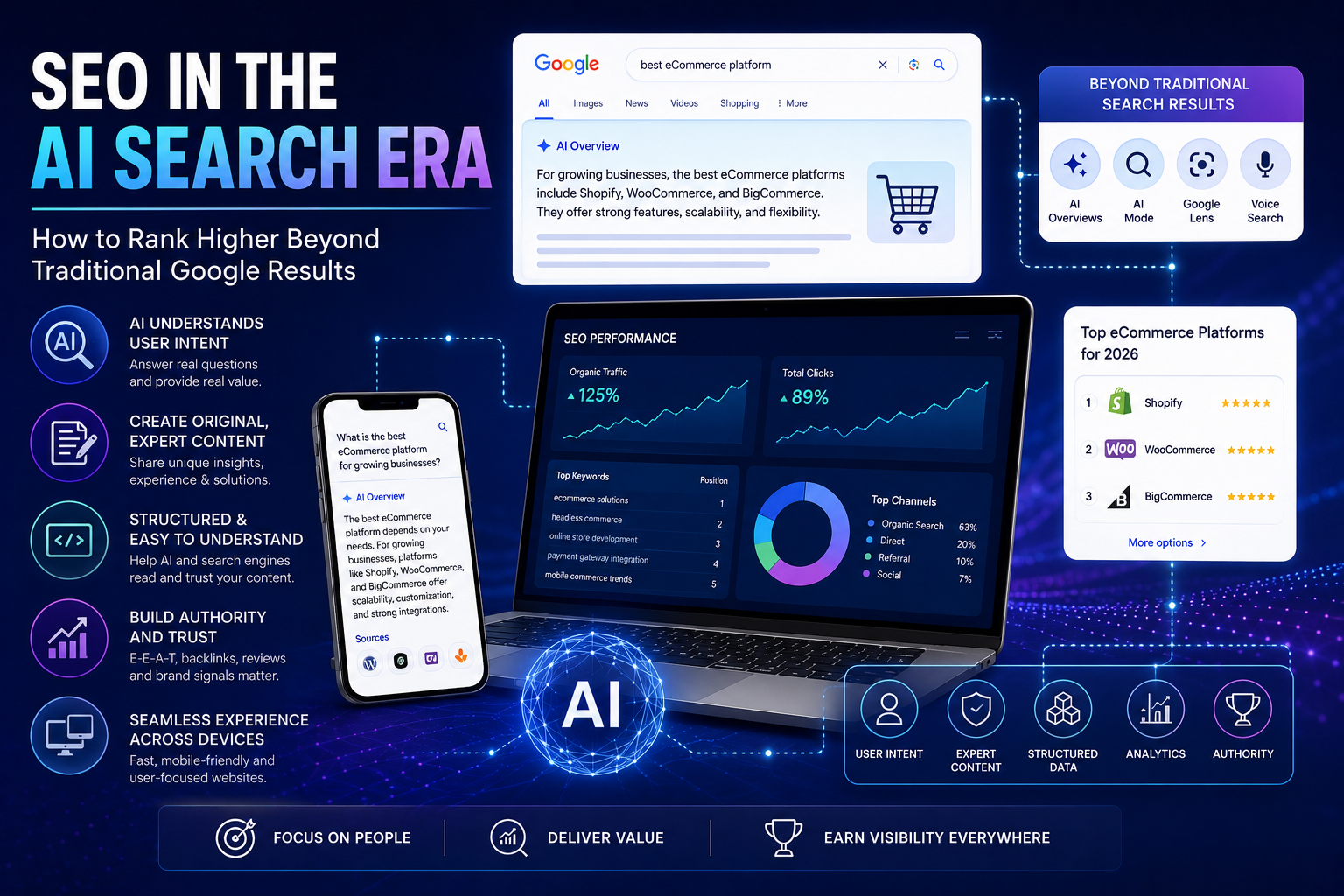
Users can ask longer and more conversational questions and receive AI-generated responses that summarize information from multiple sources. Google’s AI Overviews and AI Mode are changing how people discover information, compare products, research services, and make purchasing decisions.
This does not mean that traditional SEO is becoming irrelevant.
In fact, Google states that its existing SEO fundamentals remain important for appearing in AI-powered search experiences. The difference is that businesses now need to think beyond simply ranking for individual keywords and focus on becoming a reliable, useful, and recognizable source of information.
So, how can businesses prepare their websites for the AI search era?
What Is AI Search?
AI search refers to search experiences that use artificial intelligence to understand a user’s intent, gather information from multiple sources, and provide a more conversational or summarized response.
Traditional search often works like this:
User Query → Search Results → Website → Information
AI-powered search can work more like:
User Question → AI Understanding → Multiple Related Searches → AI-Generated Response → Supporting Sources
Google explains that AI features such as AI Overviews and AI Mode can use a technique called query fan-out, where the system performs multiple related searches to explore different aspects of a user’s question before generating a response.
This creates new opportunities for websites that provide detailed, trustworthy, and well-structured information.
Why Traditional SEO Alone Is No Longer Enough
Traditional SEO often focuses heavily on:
- Keywords
- Rankings
- Backlinks
- Metadata
- Technical optimization
- Search volume
These remain important, but AI-powered search is changing the way users discover information.
Consider a traditional search:
“Best eCommerce platform for small businesses”
A user might previously have clicked through several websites to compare options.
With AI-powered search, the user may instead ask:
“What is the best eCommerce platform for a small business that wants online payments, inventory management, mobile commerce, and room to scale?”
The search engine can interpret the broader intent and generate a response based on information gathered from multiple sources.
This means businesses need to create content that answers real customer questions, not simply content designed around isolated keywords.
1. Focus on Search Intent, Not Just Keywords
Keywords are still important, but understanding why someone is searching is becoming even more valuable.
Instead of creating an article around a keyword such as:
“eCommerce website development”
consider the questions a potential customer may actually have:
- How much does an eCommerce website cost?
- What features should an online store have?
- How long does it take to build an eCommerce website?
- Should a business choose a marketplace or standalone store?
- How can an eCommerce website integrate with an ERP?
- How can an online store improve conversion rates?
These questions represent different stages of the customer’s decision-making process.
Creating useful content around these topics gives search engines more context about your expertise while providing genuine value to potential customers.
2. Create Original, Experience-Based Content
AI can generate thousands of articles in a short period of time.
This makes generic content increasingly common.
Businesses that simply publish AI-generated articles containing information already available across hundreds of websites may struggle to stand out.
Google’s current guidance emphasizes unique, valuable, non-commodity content and people-first information.
Instead of simply explaining what something is, demonstrate real expertise.
For example, an eCommerce development company could create content based on:
- Real implementation challenges
- Industry-specific recommendations
- Integration considerations
- Common project mistakes
- Lessons from real projects
- Technical comparisons
- Business use cases
- Before-and-after improvements
- Expert opinions
This type of content provides information that generic AI-generated pages cannot easily replicate.
3. Build Topic Authority
One of the biggest changes in modern SEO is the move from individual keyword targeting toward topic authority.
Instead of writing one article about eCommerce, businesses can build a content ecosystem.
For example:
Main Topic
eCommerce Development
Supporting Topics
- eCommerce platform selection
- eCommerce UX
- Payment gateway integration
- ERP integration
- Inventory management
- Mobile commerce
- eCommerce security
- AI-powered personalization
- eCommerce SEO
- Conversion rate optimization
These articles can be connected through internal links to create a strong topical structure.
This helps users navigate the website while giving search engines clearer context about the site’s areas of expertise.
4. Make Content Easy for AI Systems to Understand
AI search systems need to identify information from web pages.
That makes content structure increasingly important.
Avoid presenting important information as one large block of text.
Instead, use:
- Clear headings
- Short paragraphs
- Bullet points
- Numbered steps
- Comparison tables
- FAQs
- Definitions
- Examples
- Relevant images
- Descriptive captions
For example, instead of writing several paragraphs about the benefits of an eCommerce platform, create a clearly structured section:
Benefits of an eCommerce Platform
Scalability: Supports business growth.
Integration: Connects with ERP, payment, logistics, and marketing systems.
Personalization: Enables personalized product recommendations.
Analytics: Provides insights into customer and sales behavior.
This makes information easier for both people and search systems to interpret.
5. Strengthen Your Website’s Technical SEO
AI search does not eliminate technical SEO.
Google’s current guidance specifically states that pages need to be accessible, crawlable, indexable, and eligible to appear in Google Search to be considered for AI-powered search features.
Businesses should therefore continue focusing on:
- Crawlability
- Indexability
- Mobile responsiveness
- Page speed
- Core Web Vitals
- Internal linking
- HTTPS
- Clean URL structures
- XML sitemaps
- Canonical URLs
- JavaScript SEO
- Structured data
A website may have excellent content, but if search engines cannot properly access or understand it, that content may never reach the intended audience.
6. Use Structured Data Correctly
Structured data helps search engines understand the information presented on a page.
Depending on the content, businesses can use relevant Schema.org structured data such as:
- Organization
- Product
- Article
- Breadcrumb
- Local Business
- FAQ where applicable
- Review-related structured data where eligible
However, businesses should not treat schema as a shortcut to AI visibility.
Google’s current guidance makes an important point: there is no special AI schema or markup required specifically to appear in AI Overviews or AI Mode. Existing SEO best practices and accurate structured data remain the foundation.
The key principle is simple:
Use structured data to accurately describe visible content—not to manipulate search engines.
7. Demonstrate Experience, Expertise, and Trust
When AI systems are selecting information to support an answer, credibility matters.
Businesses should clearly demonstrate who is behind their content and why they are qualified to discuss a particular subject.
This can include:
- Author information
- Company information
- Industry experience
- Case studies
- Client examples
- Original research
- Expert commentary
- References to reliable sources
- Transparent business information
For example, a technology company discussing payment gateway integration can strengthen its content by explaining actual integration considerations, security requirements, implementation challenges, and business use cases.
The more useful and credible the information, the more valuable the content becomes to both users and search systems.
8. Don’t Ignore Images, Video, and Other Content Formats
AI search is becoming increasingly multimodal.
Users can search using combinations of text, images, and other formats.
Google recommends supporting textual content with relevant, high-quality images and videos where appropriate.
For businesses, this means SEO should no longer be limited to blog articles.
Consider creating:
- Product demonstrations
- Explainer videos
- Infographics
- Tutorials
- Product images
- Screenshots
- Case study visuals
- How-to videos
For an eCommerce website, high-quality product images and accurate product information can be especially important.
9. Optimize for Conversational and Long-Tail Queries
AI-powered search encourages people to ask complete questions rather than typing short keywords.
Instead of:
“eCommerce SEO”
users may search:
“How can I improve SEO for my eCommerce website and increase organic sales?”
This creates opportunities for businesses to target long-tail, conversational searches.
Useful content formats include:
How-to Guides
“How to Improve Your eCommerce Website’s SEO”
Comparison Articles
“eCommerce Website vs Marketplace: Which Is Better for Your Business?”
Problem-Solving Articles
“Why Is My eCommerce Website Getting Traffic but No Sales?”
Industry Guides
“How Retail Businesses Can Build an Omnichannel eCommerce Strategy”
Frequently Asked Questions
“What Features Should a Modern eCommerce Website Have?”
These formats align naturally with the way people ask questions in AI-powered search environments.
10. Build Strong Internal Linking
Internal linking is often overlooked.
However, a well-connected website helps users and search engines discover related information.
For example:
eCommerce Development
↓
Mobile Commerce
↓
Payment Gateway Integration
↓
eCommerce Security
↓
AI Product Recommendations
This creates a connected content ecosystem.
When writing a new article, look for opportunities to link to relevant existing pages and resources.
The objective should not be to add as many links as possible, but to provide useful pathways for users to explore related information.
11. Don’t Chase “AI SEO Hacks”
The rise of AI search has created new terms such as:
- AEO — Answer Engine Optimization
- GEO — Generative Engine Optimization
- AI SEO
- LLM Optimization
These terms can be useful for describing emerging practices, but businesses should be cautious about strategies that promise guaranteed visibility through special tricks.
Google’s 2026 guidance specifically warns against approaches such as creating unnecessary content variations, AI-specific text files, or other supposed “GEO hacks.” Google recommends continuing to focus on strong SEO fundamentals and useful, people-first content.
In other words:
Don’t try to optimize for an AI system instead of your customers.
Optimize your website so that both customers and search systems can understand its value.
12. Measure More Than Rankings
In the traditional SEO model, businesses often focused on:
Keyword → Ranking → Click
The AI search environment requires a broader view.
Businesses should consider:
- Organic traffic
- Impressions
- Click-through rates
- Leads
- Sales
- Conversion rates
- Engagement
- Time spent on site
- Returning visitors
- Brand searches
- Visibility in AI-powered search features
Google announced new Search Console reporting in June 2026 to provide dedicated visibility into impressions from generative AI features such as AI Overviews and AI Mode. The feature is being rolled out to a subset of websites initially.
This signals an important shift: measuring search visibility is becoming broader than simply tracking traditional blue-link rankings.
13. Optimize for the Entire Customer Journey
SEO should not end when someone clicks on your website.
The real goal is to turn search visibility into business value.
Consider the journey:
Search → Website → Information → Trust → Enquiry → Purchase
If the website loads slowly, has confusing navigation, lacks useful information, or provides a poor mobile experience, ranking alone will not generate meaningful business results.
Businesses should therefore connect SEO with:
- UX design
- Content marketing
- Conversion optimization
- eCommerce
- Analytics
- Customer experience
- Digital marketing
Modern SEO is increasingly part of the entire digital customer journey.
The Future of SEO: From Ranking Pages to Becoming a Trusted Source
The biggest change in AI-powered search is not simply the appearance of AI-generated answers.
It is the shift in how people discover information.
Search is moving from:
“Find me a webpage.”
toward:
“Help me solve this problem.”
This creates an opportunity for businesses that genuinely understand their customers.
A company that consistently publishes useful guides, original insights, expert knowledge, product information, case studies, and practical solutions can build visibility across traditional search and emerging AI-powered experiences.
The objective is no longer just to rank for one keyword.
The objective is to become a trusted source within your industry.
A Practical AI-Era SEO Strategy
Businesses looking to prepare for the changing search landscape can start with the following approach:
1. Audit Your Existing Website
Identify technical SEO problems, outdated content, broken links, duplicate pages, and indexing issues.
2. Understand Your Audience
Identify the questions customers ask before, during, and after making a purchasing decision.
3. Build Topic Clusters
Create interconnected content around your key products, services, and areas of expertise.
4. Improve Existing Content
Update outdated articles with current information, examples, statistics, visuals, and expert insights.
5. Create Original Content
Focus on information based on real experience, research, case studies, and industry knowledge.
6. Improve Technical SEO
Make sure search engines can crawl, understand, and index your website effectively.
7. Strengthen Internal Linking
Connect related pages to create a clear content structure.
8. Use Structured Data Where Appropriate
Ensure your structured data accurately reflects the visible content on your pages.
9. Optimize for Multiple Formats
Use text, images, video, infographics, and other relevant formats.
10. Track Business Outcomes
Measure conversions and customer engagement—not just keyword positions.
Conclusion
The rise of AI-powered search does not mean the end of SEO.
It represents the next evolution of search.
Google’s current guidance makes it clear that foundational SEO remains important for AI-powered search experiences, while the growing importance of original, useful, people-first content creates new opportunities for businesses that can demonstrate genuine expertise.
The businesses that succeed in this new environment will not necessarily be those that publish the most content or chase the latest SEO shortcut.
They will be the businesses that provide the most useful answers, the clearest information, the strongest user experience, and the greatest level of trust.
The future of SEO is therefore not about optimizing only for Google.
It is about creating a digital presence that can be discovered, understood, trusted, and recommended across the evolving search ecosystem.
SEO is no longer just about ranking higher. It’s about becoming the source people—and intelligent search systems—can rely on.

1 Comment
Blog | Xiteb | Web & Mobile Software Solutions Provider – Web & Mobile Software Solutions Provider · October 4, 2026 at 6:32 pm
[…] […]